

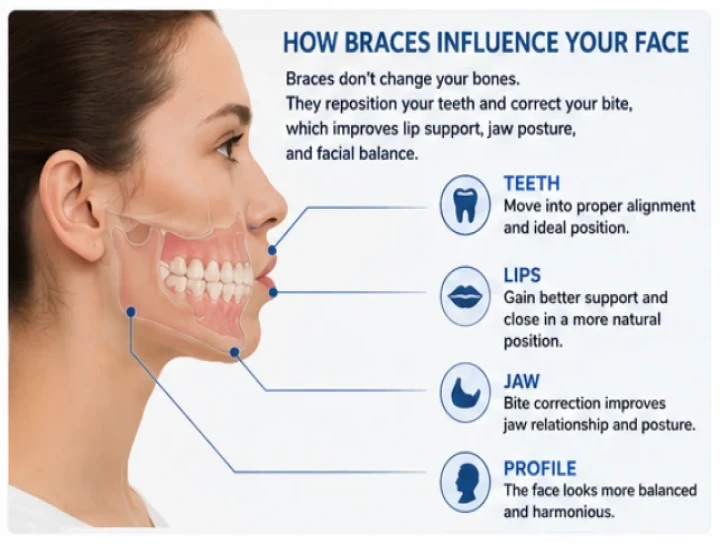
Can Orthodontics Change Your Face? 🦷✨
“Will braces change my face?”
It’s one of the most common questions patients ask before starting orthodontic treatment.
The short answer is: yes, orthodontic treatment can influence facial appearance—but it depends on what is being treated.
Your face is closely connected to your teeth, jaws, lips, and surrounding soft tissues. When orthodontic treatment moves teeth, it can change the support provided to the lips and alter the way the lips, teeth, and cheeks relate to one another.
For example, retracting prominent incisors may reduce lip prominence, while correcting severely proclined or retroclined teeth can improve lip posture. Expansion or correction of certain transverse discrepancies can also influence the appearance of the smile.
But orthodontics does not simply “reshape” the entire face.
The extent of facial change depends on factors such as age, growth pattern, skeletal discrepancy, tooth movement, treatment mechanics, and soft-tissue response. In growing patients, orthopedic or growth-modification treatment may influence the underlying skeletal relationships to a greater extent than routine tooth movement in adults.
This is why two patients receiving seemingly similar orthodontic treatment can experience very different changes in facial appearance.
Ultimately, orthodontics is not just about moving teeth into a straight line.
It is about creating a better relationship between teeth, jaws, lips, and the face.
So, can braces change your face?
They can—but the goal is not to create a new face. It is to bring the existing face into better balance and harmony.
No Any Replies to “Can Orthodontics Change Your Face? 🦷✨”
Leave a Reply