

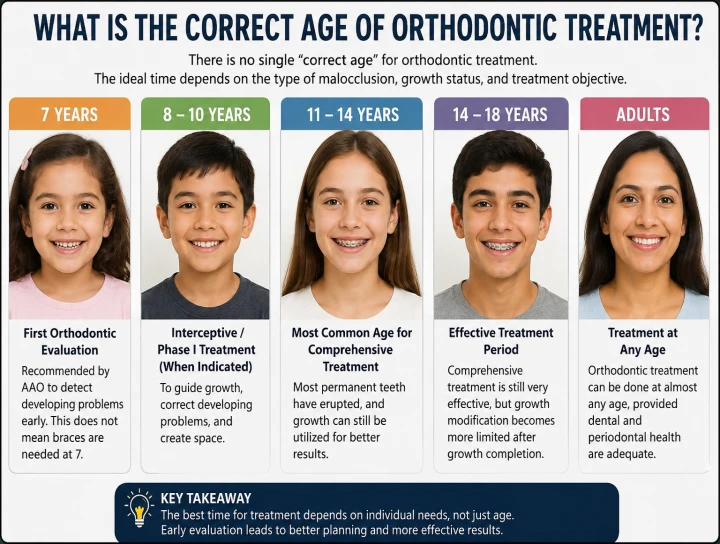
What Is the Right Age for Orthodontic Treatment?
“When should my child get braces?”
This is one of the most common questions parents ask an orthodontist. While many people believe that orthodontic treatment should only begin during the teenage years, the truth is that there is no single correct age for orthodontic treatment.
The ideal time depends on the child’s dental development, jaw growth, type of malocclusion, and individual treatment needs.
When Should Your Child First Visit an Orthodontist?
It is generally recommended that a child has their first orthodontic evaluation around the age of 7 years.
At this age, the first permanent molars and incisors have usually erupted, allowing an orthodontist to identify developing problems with:
- Tooth eruption
- Crowding and spacing
- Jaw relationships
- Crossbites
- Excessive overjet or deep bite
- Oral habits
- Developing skeletal discrepancies
- However, an orthodontic consultation at 7 does not mean that braces need to be placed at 7.
- Sometimes, the best treatment is simply to monitor the child’s growth and dental development and begin treatment at the appropriate time
8–10 Years: When Early Treatment May Be Needed
Some orthodontic problems benefit from treatment before all the permanent teeth have erupted.
This is known as interceptive or Phase I orthodontic treatment.
Early treatment may be considered in situations such as:
- Anterior or posterior crossbite
- Functional mandibular shifts
- Severe crowding
- Ectopic eruption of permanent teeth
- Certain developing Class II or Class III skeletal problems
- Harmful oral habits
- Significant jaw discrepancies
The objective of early treatment is not always to complete the entire orthodontic correction. Instead, it may be used to correct a developing problem, guide jaw growth, create space, or simplify future treatment.
11–14 Years: A Common Age for Braces
For many children, 11–14 years is a common age for comprehensive orthodontic treatment.
By this stage, most permanent teeth have erupted, making it possible to align the teeth and correct the bite more comprehensively.
This period can also be advantageous because the child may still have considerable facial growth remaining, which can be utilized in selected cases.
However, the exact timing varies from child to child. Two children of the same chronological age may have very different stages of dental and skeletal development.
Is Age More Important Than Growth?
Not always.
When orthodontists plan treatment, they consider much more than the patient's age.
Important factors include:
Chronological age + Dental age + Skeletal maturity + Growth pattern + Severity of malocclusion
This is particularly important when treatment involves growth modification.
For example, certain skeletal Class II or Class III problems may benefit from treatment during a specific phase of growth. Therefore, skeletal maturity can be more important than simply knowing the patient's age.
What About Teenagers and Adults?
It is never “too late” to consult an orthodontist.
Teenagers who have not previously undergone treatment can still achieve excellent results. Similarly, adults can undergo orthodontic treatment at almost any age, provided their teeth, gums and supporting bone are healthy.
Modern orthodontics offers several options, including:
- Conventional braces
- Ceramic braces
- Self-ligating appliances
- Clear aligners
- Other customized orthodontic approaches
The treatment option depends on the patient's individual condition and treatment goals.
So, What Is the “Perfect” Age?
There isn't one.
A useful way to remember it is:
Around 7 years → First orthodontic evaluation
8–10 years → Early/interceptive treatment when indicated
11–14 years → Common age for comprehensive orthodontic treatment
Teenage and adult years → Treatment is still possible and often highly successful
The most important point is that orthodontic treatment should be based on the individual patient—not simply their age.
The Bottom Line
The best time to begin orthodontic treatment is when the orthodontic problem is diagnosed and the patient is at the most appropriate stage of dental and skeletal development for that particular treatment.
So rather than waiting for a specific birthday, schedule an orthodontic evaluation early. Early assessment allows an orthodontist to decide whether treatment is needed now, later, or not at all.
A timely orthodontic evaluation can make treatment more predictable, efficient, and personalized.
No Any Replies to “What is the correct age of Orthodontic treatment?”
Leave a Reply