

Ever had a root canal treatment done? Seen your dentist taking mental and physical notes of measurements?
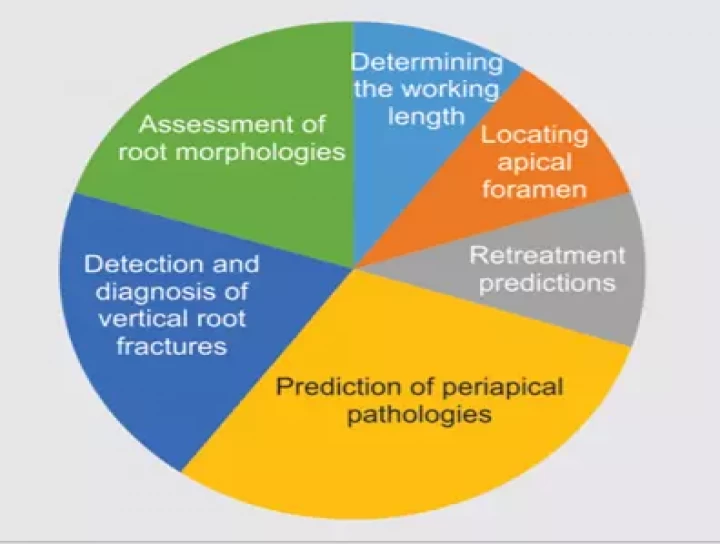
Endodontists use radiographic images to examine, measure, and evaluate the condition of the root.
AI has applications that can help dentists detect and treat these dreaded pathologies even more effectively. Deep learning algorithms can detect, locate, and classify different aspects of tooth root anatomy and possible pathologies.
AI models can also look at these images and determine the structure, measurements, tissue viability, and even potential success of treatment for those out-of-sight portions of the tooth.
Dental caries
As with oral cancer, early detection of dental caries is critical to preventing irreversible harm. When cavities are diagnosed and treated early, it significantly reduces the cost of treatment, time of restoration, and risk of tooth loss. Computer-aided detection and diagnosis systems (CAD) are making their way toward becoming a standard part of dental clinics. These systems can read dental X-rays and cone-beam computed tomography (CBCT) images for signs of oral pathology. They are particularly good at using pictures of dental X-rays to spot dental caries that occur between teeth, which are often quite difficult to see with the naked eye.
Oral cancer detection
Losing a tooth can be a trauma, but inexplicable harm of oral cancer overpowers it multifold.
Visible oral lesions called “oral potentially malignant disorders” (OPMDs) are a strong sign of cancer and their detection during routine examination helps the patient immensely. The problem is that this kind of examination just doesn’t occur frequently enough during dental checkups.
Programmers are already working hard on annotating dental data and building models for oral cancer detection. Image classification managed an accuracy of 87% for detecting the presence of oral lesions and 78% accuracy for classifying those that needed referral for treatment. Object detection fared somewhat worse, with only 41% accuracy detecting lesions that posed a cancer risk. While not perfect, the AI system yielded promising results.
Periodontal health
Health of the gum tissue goes a long way in keeping those pearls in your mouth, healthy and firm, for a long time.
For periodontal diseases, dentists can determine how advanced the disease is with a technique called depth probing. Luckily, AI can help out by providing additional detection tools and automated depth probing. By image classification and segmentation on radiographic images of periodontally compromised teeth, they identify patterns and perform edge detection to determine the stage of the disease.
The presence of artificial intelligence for dentistry is hard to understate. When working with human dental practitioners, AI technologies improve diagnostic accuracy, reduce costs and improve long-term patient outcomes.
No Any Replies to “Smart Dentistry”
Leave a Reply