

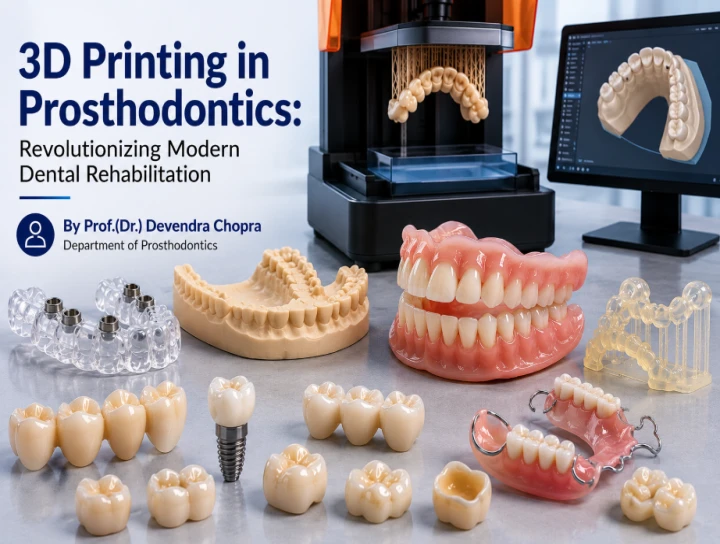
3D Printing in Prosthodontics: Revolutionizing Modern Dental Rehabilitation
By [Prof. Dr. Devendra Chopra]
Department of Prosthodontics
Introduction
The integration of digital technology into dentistry has transformed the way prosthodontic treatments are planned and delivered. Among these innovations, 3D printing has emerged as one of the most significant advancements, offering unprecedented precision, efficiency, and customization in the fabrication of dental prostheses. From diagnostic models to complete dentures, 3D printing is reshaping the future of prosthodontics and improving patient outcomes.
Understanding 3D Printing in Dentistry
3D printing, also known as additive manufacturing, is a process in which objects are created layer by layer from digital designs. In prosthodontics, a digital workflow typically begins with intraoral scanning or cone-beam computed tomography (CBCT) imaging. The acquired data are converted into a digital model using computer-aided design (CAD) software and subsequently fabricated using a 3D printer.
This technology allows dental professionals to produce highly accurate and patient-specific restorations with minimal material wastage.
Applications of 3D Printing in Prosthodontics
1. Diagnostic and Working Models
3D-printed models provide accurate replicas of patients' oral structures. These models facilitate treatment planning, case presentations, and laboratory procedures while reducing production time compared to conventional stone casts.
2. Complete Dentures
Digital denture fabrication has gained popularity due to its accuracy and reproducibility. 3D-printed dentures can be designed and manufactured with fewer clinical appointments, enhancing patient comfort and satisfaction.
3. Crowns and Bridges
Temporary crowns and bridge restorations can be fabricated rapidly using 3D printing technology. The digital workflow ensures excellent fit and esthetics while reducing turnaround time.
4. Implant Prosthodontics
Surgical guides produced through 3D printing assist clinicians in precise implant placement. Accurate implant positioning improves prosthetic outcomes and minimizes surgical complications.
5. Maxillofacial Prostheses
Patients with facial defects resulting from trauma, congenital anomalies, or cancer treatment can benefit from customized prostheses fabricated using 3D printing. This technology enhances both functional rehabilitation and esthetic outcomes.
Advantages of 3D Printing in Prosthodontics
- Enhanced Accuracy: Digital workflows reduce human errors and improve prosthesis fit.
- Customization: Prostheses can be tailored precisely to individual patient anatomy.
- Reduced Treatment Time: Faster production decreases laboratory and chairside time.
- Cost Efficiency: Material wastage is minimized, making fabrication more economical in the long term.
- Improved Patient Experience: Fewer appointments and predictable outcomes contribute to higher patient satisfaction.
- Digital Storage: Patient records and designs can be stored electronically for future reference or reproduction.
Challenges and Limitations
Despite its numerous advantages, 3D printing in prosthodontics faces certain challenges:
- High initial investment in equipment and software.
- Requirement for technical expertise and training.
- Limited availability of approved printable materials for some definitive restorations.
- Need for standardization and long-term clinical studies to evaluate durability and performance.
Future Perspectives
The future of prosthodontics is increasingly digital. Advances in biomaterials, artificial intelligence, and bioprinting are expected to further expand the capabilities of 3D printing. Researchers are exploring the possibility of printing tissues and bioengineered structures, which may revolutionize oral rehabilitation in the coming decades.
Conclusion
3D printing has become a transformative force in prosthodontics, offering improved precision, efficiency, and patient-centered care. As technology continues to evolve, its applications will likely expand, making digital dentistry an integral component of modern prosthodontic practice. Embracing these innovations will enable dental professionals to deliver higher-quality treatments while enhancing patient satisfaction and clinical outcomes.
Keywords: 3D Printing, Prosthodontics, Digital Dentistry, CAD/CAM, Dental Prostheses, Implant Dentistry, Additive Manufacturing, Dental Technology.
No Any Replies to “3D Printing in Prosthodontics: Revolutionizing Modern Dental Rehabilitation”
Leave a Reply