

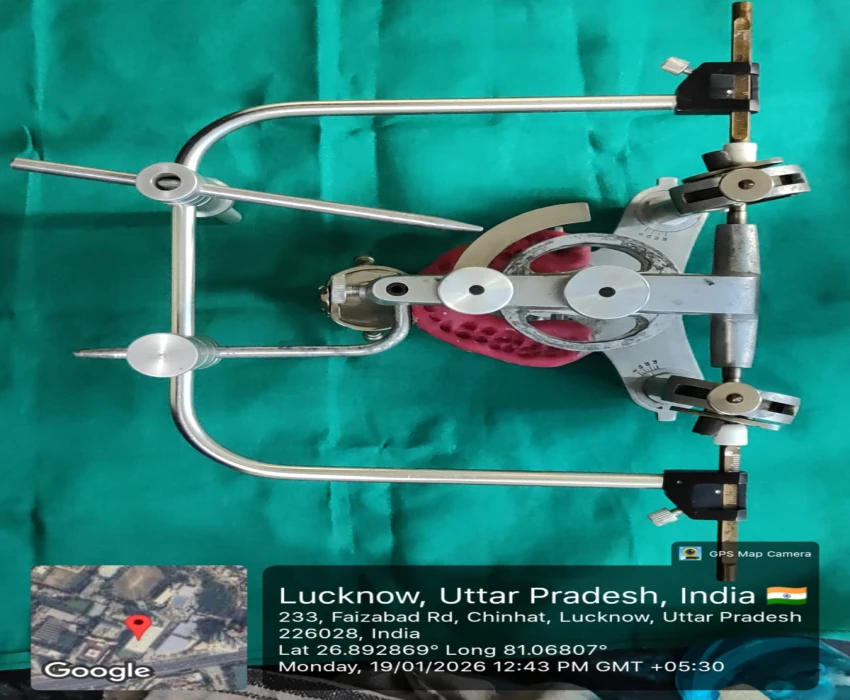

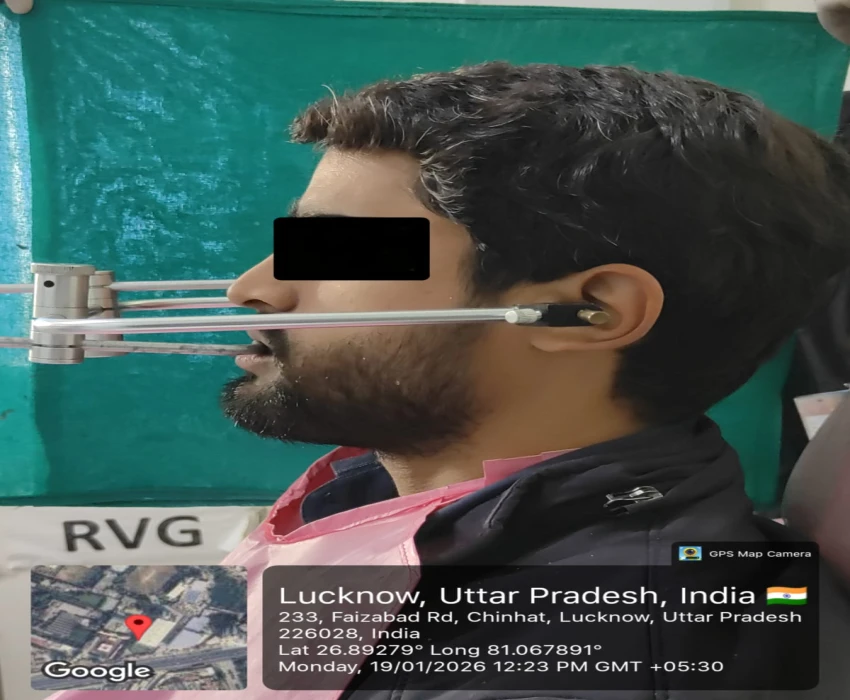
Facebow transfer for orthognathic surgery records the 3D spatial orientation of the patient's maxillary dentition relative to the skull's hinge axis and horizontal plane (often Frankfort). This data is transferred to an articulator to accurately mount the maxillary cast, facilitating proper occlusion planning and construction of intermediate surgical wafers.
Key Aspects of Facebow Transfer for Orthognathic Surgery
Purpose: It ensures the maxillary cast on the articulator mimics the patient's actual, unique jaw position, accounting for deviations like canting or pitch.
Procedure: A bite fork with impression material is positioned in the mouth to record the occlusal plane, which is then connected to the ear-bow device.
Components: The process commonly involves the ear-bow, a bite fork, a transfer assembly (like a Denar Slidematic), and a stable, indexed maxillary cast.
Reference Points: Typically uses the external auditory meatus (ears) and a third point (like the infraorbital notch) to define the horizontal plane.
Limitations: While useful for physical mounting, research indicates that traditional facebow transfers can have inaccuracies, prompting some to use virtual 3D, image-based planning instead.
Importance in Surgical Planning
Captures Asymmetry: The transfer records right-left or forward-backward tilting of the maxilla.
Prevents Errors: Without it, incorrect mounting could lead to a flawed surgical plan, such as a midline cant.
Improves Accuracy: It is essential for determining the correct rotational axis for maxilla movement.
No Any Replies to “Facebow Transfer for Orthognathic Surgery”
Leave a Reply