

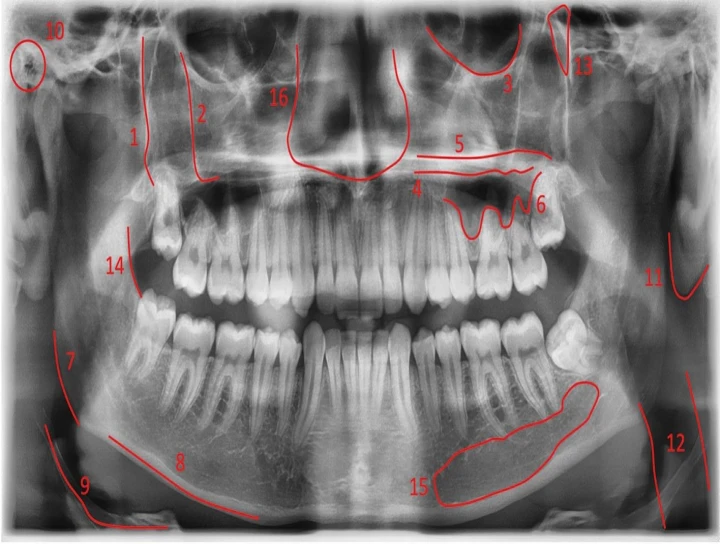
Post-Processing of Panoramic Radiographs: Demystifying Its Veracity
Panoramic radiography is a widely used imaging modality in dental and maxillofacial practice, providing a comprehensive overview of the jaws, teeth, and adjacent anatomical structures in a single image. Despite its advantages of broad coverage, low radiation dose, and ease of acquisition, panoramic radiographs are inherently limited by image distortion, superimposition, and reduced spatial resolution. To overcome these limitations and enhance diagnostic utility, post-processing techniques are routinely employed. Understanding the veracity and limitations of post-processed panoramic images is essential to ensure accurate interpretation and avoid diagnostic pitfalls.
Post-processing refers to digital manipulation of radiographic images after acquisition to improve visual quality and highlight diagnostically relevant features. Common post-processing techniques include adjustment of brightness and contrast, edge enhancement, sharpening, noise reduction, inversion, pseudocolor application, and zooming. These tools can improve visualization of anatomical landmarks, periodontal bone levels, impacted teeth, and pathological lesions. For example, contrast enhancement can aid in identifying subtle radiolucencies, while sharpening may improve the delineation of cortical borders.
However, the veracity of post-processed panoramic radiographs depends on appropriate and judicious use. Excessive manipulation can introduce artifacts, exaggerate anatomical features, or mask true pathology. Over-sharpening may create false radiopaque lines, mimicking fractures or sclerosis, while aggressive contrast enhancement may obscure soft tissue shadows or produce artificial radiolucencies. Therefore, post-processing should be used as an adjunct rather than a substitute for sound radiographic technique and clinical correlation.
Another important consideration is that post-processing does not correct inherent geometric distortions of panoramic imaging. Magnification errors, ghost images, and overlapping structures remain unchanged despite digital enhancement. Clinicians must be aware that measurements derived from panoramic radiographs, even after post-processing, may not be accurate and should not be relied upon for precise dimensional analysis, particularly in implant planning or surgical procedures.
The diagnostic value of post-processing also depends on the quality of the original image. A poorly positioned or motion-blurred panoramic radiograph cannot be reliably “rescued” through post-processing alone. Optimal patient positioning, correct exposure parameters, and proper machine calibration are prerequisites for meaningful post-acquisition enhancement. Post-processing can refine image interpretation but cannot compensate for fundamental acquisition errors.
From a medico-legal perspective, transparency in image manipulation is crucial. Original, unaltered images should always be retained alongside processed versions to maintain diagnostic integrity and legal defensibility. Documentation of post-processing steps ensures reproducibility and prevents misinterpretation in clinical audits or expert reviews.
In contemporary practice, artificial intelligence–assisted post-processing algorithms are being developed to automatically enhance panoramic images and assist in lesion detection. While these technologies show promise, they must be validated rigorously and used under clinician supervision to avoid over-reliance on automated interpretations.
In conclusion, post-processing of panoramic radiographs is a powerful tool that enhances image readability and diagnostic confidence when applied appropriately. Demystifying its veracity requires understanding both its capabilities and limitations. When used judiciously, in conjunction with high-quality image acquisition and clinical correlation, post-processing can significantly augment the diagnostic value of panoramic radiography without compromising accuracy.
No Any Replies to “Post-Processing of Panoramic Radiographs: Demystifying its Veracity”
Leave a Reply